Vacuum technology is one of the cornerstones of cutting edge science and engineering. Whether in semiconductor fabrication, particle physics, nuclear fusion, or maybe in meals packaging, having particular manage over stress beneath atmospheric ranges has unlocked infinite breakthroughs. In this text, we delve deep into the vacuum era, its history, fundamentals, sorts, key components, major programs, recent improvements, and future directions. We will aim to exceed the depth of normal resources, imparting sparkling insights and complete tables of crucial facts to make your expertise stronger.
What is Vacuum Technology?
Vacuum technology refers to the technological know how and engineering involved in creating and retaining an environment where the strain of gases is a whole lot lower than ambient atmospheric strain. Depending on how low the stress is, distinct bodily phenomena come to be dominant, allowing technologies that otherwise wouldn’t feature or might be inefficient or risky.
Table of Contents
Key phrases:
- Atmospheric pressure: Approx. One zero one,325 Pa (or 760 torr) at sea level.
- Low, medium, excessive, ultra high, extreme high vacuum: Different regimes of vacuum, every with its personal challenges and technologies.
- Vacuum pump: Device to get rid of gasoline molecules from a sealed extent to lessen pressure.
- Vacuum gauge / dimension: Tools to measure stress in various regimes.
Historical Evolution of Vacuum Technology
| Time Period | Major Developments | Notable Inventors / Instruments |
| 17th–18th Centuries | Foundational experiments in vacuum: Torricelli’s barometer; Otto von Guericke’s air pump; Boyle’s law establishing relationship between pressure & volume. | Otto von Guericke; Robert Boyle; Fr ancis Haukesbee |
| 19th Century | Improved piston pumps; development of vacuum gauges; first industrial uses (light bulbs, electron tubes). | Edison, Pirani, Bayard-Alpert gauge development |
| 20th Century | Rise of high vacuum & ultra-high vacuum; diffusion, turbomolecular, cryogenic pumps; vacuum in electronics, space research, nuclear applications. | Semiconductor industry, space agencies, research labs |
| 21st Century | Ultra-clean and ultra-high vacuum (UHV & XHV); precision leak detection; miniaturization; vacuum in nanotechnology, quantum tech; energy-efficient systems. | Research into cold atom vacuum standards; innovations in coatings; plasma tech; sustainable vacuum solutions |
Fundamentals of Vacuum Science
Vacuum Regimes & Pressure Ranges
| Regime | Pressure Range | Typical Units | Where It’s Used |
| Rough / Low Vacuum | ~10⁵ to ~10⁻¹ Pa | torr, mbar, Pa | Packaging, vacuum forming, food preservation. |
| Medium Vacuum | ~10⁻¹ to ~10⁻³ Pa | Pa, mbar | Metallurgy, some coating processes. |
| High Vacuum (HV) | ~10⁻³ to ~10⁻⁷ Pa | Pa, µPa | Electronics, surface science, thin film deposition. |
| Ultra-High Vacuum (UHV) | ~10⁻⁷ to ~10⁻¹² Pa | Pa, nPa | Particle accelerators, LEED, molecular beam epitaxy, quantum experiments. |
| Extreme-High Vacuum (XHV) | Below ~10⁻¹² Pa | Pa, ultra-tiny units | Cutting edge physics experiments, fundamental vacuum research. |
Core Components & Technologies
| Component | Function | Key Types / Examples |
| Vacuum Pumps | Remove gas molecules to reduce pressure | Rotary vane pumps; dry mechanical pumps; diffusion pumps; turbomolecular pumps; ion pumps; cryopumps. |
| Vacuum Gauges & Measurement | Measure the pressure (degree of vacuum) | Thermal conductivity gauges; hot and cold cathode ionization gauges; Pirani gauge; Bayard-Alpert gauge; modern standards like cold-atom vacuum standards. |
| Vacuum Chambers & Seals | Enclosures that maintain vacuum; ensuring leaks are minimized | Materials need good sealing, low outgassing; use of special seals (metal, elastomer, ceramic). |
| Leak Detection & Maintenance | Ensure system integrity; find and fix leaks; maintain performance | Helium leak detectors; bake-out procedures; surface cleaning; proper selection & maintenance of pump oil or dry systems. |
Types of Vacuum Pumps & How They Compare
| Pump Type | Pressure Range Best Suited For | Advantages | Disadvantages / Considerations |
| Rotary Vane / Oil-Sealed Pumps | Low to medium vacuum | Reliable; good compression; common & cost-effective; good as roughing pumps. | Oil contamination risk; maintenance of seals; lower ultimate vacuum. |
| Dry Mechanical Pumps | Low to medium vacuum | No oil; cleaner; less maintenance. | Higher cost; may have shorter lifespans under heavy load. |
| Diffusion Pumps | High vacuum | Can reach good HV; high pumping speed. | Need good forepump; possible backstreaming of oil; thermal challenges. |
| Turbomolecular Pumps | High to ultra-high vacuum | Clean; high ultimate vacuum; fast equilibration. | Expensive; sensitive; needs backing pump; requires careful cooling. |
| Cryogenic Pumps | Very high / UHV | Excellent for certain gas species; very low pressures; useful in scientific setups. | Cooling requirements; periodic regeneration; bulky setup. |
| Ion Pumps & Getter Pumps | UHV / XHV | Very clean vacuum; minimal maintenance; good for stable long term UHV. | Low pumping speed for bulk gas; only suitable for certain gases; expensive. |
Major Applications of Vacuum Technology
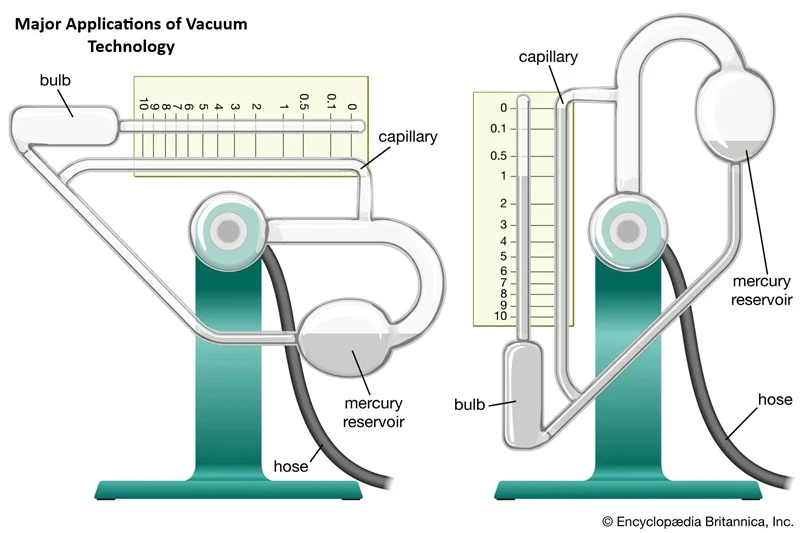
Below are some of the important software regions, showing how essential vacuum technology is throughout sectors.
| Industry / Field | Specific Applications | Why Vacuum Matters (Benefits) |
| Semiconductor & Electronics | Integrated circuits, wafer deposition, etching, lithography. | Prevent contamination; control reaction environment; allow precise thin-film growth. |
| Space & Aerospace | Space simulation chambers; material testing under vacuum; spacecraft components. | Needs to mimic space conditions; reduce drag; manage outgassing; thermal management. |
| Scientific Research / Physics | Particle accelerators; surface analysis; quantum experiments; UHV chambers. | Many phenomena only observable at extremely low pressures; removal of gas interference. |
| Coating, Thin Films & Metallurgy | Vacuum deposition; sputtering; vacuum sintering; metallurgical processing. | Cleaner coatings; better material properties; ability to work with reactive metals without oxidation. |
| Medical & Healthcare | MRI, cyclotrons, sterilization, pharmaceutical packaging. | Improved imaging & accelerator performance; contamination control; shelf life extension. |
| Food Processing & Packaging | Vacuum sealing; packaging; removal of air to preserve freshness. | Extend shelf life; reduce spoilage; reduce oxidation. |
| Energy | Nuclear; fusion research; vacuum insulation; solar panel manufacture. | Key for high performance, safety, efficiency; vacuum insulation reduces heat loss; vacuum deposition for solar tech. |
Recent Innovations & Trends in Vacuum Technology
- Ultra High Vacuum (UHV) & Extreme Vacuum Standards: Research into cold atom vacuum standards is enabling greater unique strain requirements and higher sensors inside the UHV/XHV regimes.
- Clean & Dry Pump Technologies: Moving away from oil primarily based pumps toward dry, low renovation, low contamination structures, particularly in semiconductor and medical packages.
- Improved Leak Detection & Better Materials: Use of new sealing materials; better floor instruction to reduce outgassing; greater touchy helium leak detection.
- Miniaturization & Portable Vacuum Systems: Vacuum chambers & systems designed for smaller scale: for quantum sensors, portable UHV structures, discipline programs.
- Vacuum in Sustainable & Green Technologies: Vacuum insulation in homes; vacuum techniques in solar tech; vacuum‐assisted packaging to lessen waste; greater energy efficient pumps.
- Advanced Coatings & Surface Engineering: Vacuum deposition for thin films, coatings, smart textiles, wear and corrosion resistance.
- Fundamental Challenges & Key Considerations
To layout or use vacuum era effectively, several hurdles should be controlled:
- Leak tightness: Even a tiny leak can degrade vacuum first rate, especially in high/extremely excessive vacuum structures.
- Outgassing & surface cleanliness: Material surfaces launch gasoline; baking out chambers and using clean materials could be very essential.
- Pump selection and compatibility: Matching the pump kind to the gases concerned, predicted load, and strain regime is essential.
- Cost & protection: Higher vacuum stages often suggest exponentially extra costs, energy use, and upkeep demands.
- Measurement precision: Vacuum gauges themselves have limits; calibration and sensor choice are critical.
- Environmental & safety issues: Handling cold or cryogenic factors; oil or fluid control; contamination; safe operation.
Table: Comparison of Vacuum Regimes, Technologies & Use Cases
| Regime | Pressure (Pa) | Typical Pumps / Technologies | Key Applications | Main Challenges |
| Low / Rough Vacuum | ~10⁵ to ~10⁻¹ | Rotary vane, dry mechanical pumps | Packaging, vacuum forming, degassing, vacuum storage | Large volumes; leaks; energy inefficiency at low pressures |
| Medium Vacuum | ~10⁻¹ to ~10⁻³ | Roots boosters, multistage mechanical pumps, oil‐sealed pumps | Metallurgy, coating, deposition, industrial drying | Oil contamination; pump wear; cost of materials |
| High Vacuum (HV) | ~10⁻³ to ~10⁻⁷ | Turbomolecular, diffusion pumps, cryopumps | Semiconductor fabrication, scientific instrumentation, thin films | Vacuum cleanliness; achieving stable vacuum; vibration / thermal effects |
| Ultra-High Vacuum (UHV) | ~10⁻⁷ to ~10⁻¹² | Ion pumps, getter pumps, cryogenic pumps, combination pump stacks | Particle physics, molecular beam epitaxy, quantum computing, surface science | Surface adsorption; extremely tight sealing; high cost; complex pump staging |
| Extreme High Vacuum (XHV) | Below ~10⁻¹² | Advanced getters, cryopumps, combinations; cutting edge detection | Fundamental physics; advanced research (e.g. gravitational wave detectors, atomic physics) | Many technical limits; tiny gas loads; measurement extremely difficult |
Future Directions & Where Vacuum Technology Is Headed
- Quantum Technologies & Ultra Sensitive Measurement: As quantum computing, quantum sensing, atomic clocks evolve, needs for XHV, extraordinarily low noise, and ultra clean surfaces will increase.
- Sustainability & Energy Efficiency: More green pumps; higher thermal design; vacuum insulation in buildings; decreased strength intake.
- Automation & Smart Vacuum Systems: Remote monitoring, predictive maintenance, controlled leak detection, included sensors.
- Materials Innovation: Low outgassing materials, better seals, superior coatings to lessen infection and improve toughness.
- Broader Applications: Expanding vacuum use in biotechnology, battery production, advanced scientific healing procedures, and novel substances.
Summary
The vacuum era encompasses techniques and gadgets to create, degree, and keep low-stress environments. It’s vital in present day technology, enterprise, area tech, electronics, and scientific fields. From the early vacuum pumps to ultra excessive vacuum structures, it drives innovation and allows approaches not possible underneath everyday atmospheric conditions.
Final Thought
The vacuum era, though invisible in each day life, is foundational to many of the maximum superior and impactful technology of our age. From allowing the fabrication of tiny semiconductor circuits to facilitating experiments probing the character of matter, managing over vacuum regimes from low to extremely high is a mark of technological adulthood. As needs grow on precision, cleanliness, sustainability, and innovation the sphere of vacuum technology will preserve evolving, unlocking possibilities we’ve got but to assume.
7 FAQs About Vacuum Technology: Comprehensive Guide, Applications & Innovations
Why is growing an extremely high vacuum so tough and highly priced?
- Because leaks, outgassing, material desorption, floor cleanliness, and the need for surprisingly green pumps and particular measurement gadgets make UHV structures complex. The smaller the pressure, the smaller the tolerable imperfections.
What sorts of pumps are used for distinct vacuum regimes?
Low / hard vacuum: rotary vane, dry mechanical pumps
Medium: roots boosters, multistage mechanical
High vacuum: turbomolecular, diffusion, cryo pumps
Ultra excessive: ion pumps, getter pumps, advanced cryo systems
How is vacuum generation utilized in semiconductor manufacturing?
- It’s essential for thin film deposition (CVD, PVD), etching, lithography, making sure clean, uncontaminated environments, and minimizing defects. Without vacuum, oxidation and impurity gases could deteriorate device overall performance.
Are there vacuum packages in renewable power?
- Yes. Vacuum deposition allows in fabricating excessive efficiency sun cells; vacuum insulation is utilized in power conservation; vacuum is also relevant to fusion studies, which if a hit, gives carbon loose energy.
What protection and maintenance issues are vital in vacuum structures?
- Managing pump oils or coolants; ensuring seals are intact; appearing bake outs; monitoring for leaks; ensuring structural safety under stress differences; coping with cryogenic components if present.
How will vacuum technology impact future technologies?
- Vacuum can be principal to quantum computing, superior sensors, space exploration, novel materials, and biotechnology. Improvements in affordability, miniaturization, performance, and intelligence (clever management) will allow broader usage across industries.