
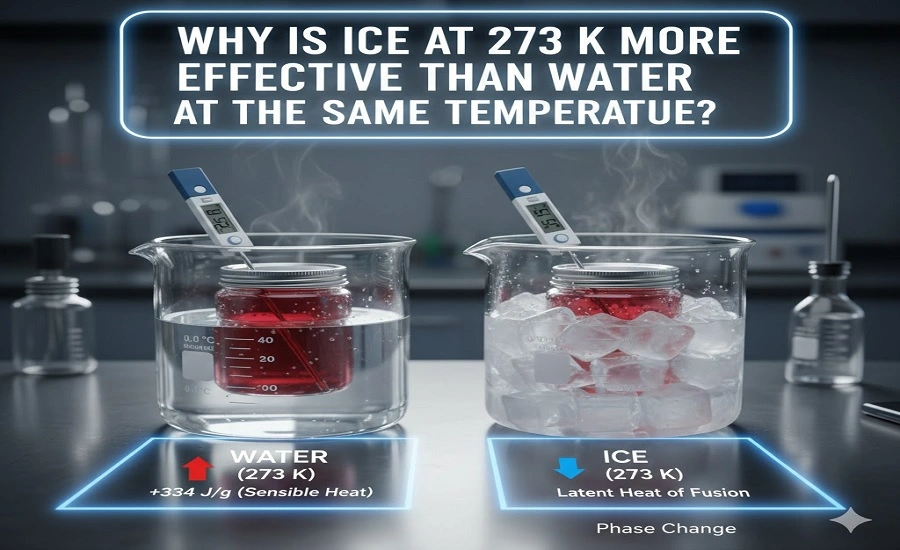
The question why is ice at 273 k more effective in cooling than water at the same temperature is one of the most crucial and typically requested ideas in thermodynamics and warmth transfer. At first look, ice and water at 273 K (0°C) seem like the identical temperature, so it could appear logical that they could cool an object similarly. However, ice cools notably greater effectively than water, and the motive lies in latent heat of fusion.
Understanding why is ice at 273 k more effective in cooling than water at the same temperature calls for a deep inspect section exchange, power absorption, and molecular conduct. This precept is extensively implemented in each day’s existence, refrigeration, climate technological know how, and physics education.
Table of Contents
Understanding Temperature and Heat: A Basic Concept
Before explaining why is ice at 273 k more effective in cooling than water at the same temperature, it’s essential to understand the distinction between temperature and warmth.
Temperature
- Measures the commonplace kinetic energy of molecules
- Indicates how warm or cold an object is
Heat
- Refers to the overall energy transferred due to temperature distinction
- Depends on mass and phase of depend
➡️ Even even though ice and water at 273 K have the identical temperature, they do not incorporate or absorb warmth within the same manner.
What Happens at 273 K?
At 273 K (0°C):
- Ice is at its melting issue
- Water is at its freezing factor
- Ice and water can coexist in equilibrium
The key reason why ice at 273 K is more powerful in cooling than water at the identical temperature lies in the power required to alternate ice into water.
Role of Latent Heat of Fusion
What Is Latent Heat of Fusion?
Latent warmness of fusion is the quantity of warmth required to convert 1 kg of ice at 273 K into water at 273 K without converting temperature.
🔹 For ice:
- Latent warmth of fusion = 334,000 J/kg
This power is absorbed with non-temperature upward thrust, making ice an exceptionally effective cooling agent.
Why Ice Absorbs More Heat Than Water at 273 K
To absolutely recognize why ice at 273 K is more powerful in cooling than water at the equal temperature, evaluate how each behaves while placed in contact with a warmer object.
Ice at 273 K
- Absorbs warmness to destroy intermolecular bonds
- Uses electricity to exchange segment (strong → liquid)
- Removes a large quantity of warmth from surroundings
Water at 273 K
- Cannot go through a section trade
- Only absorbs sensible warmness
- Temperature rises quickly after soaking up a small amount of heat
👉 This is the core reason why ice provides extra cooling.
Energy Comparison Table: Ice vs Water at 273 K
| Substance | Temperature | Heat Absorbed | Cooling Effect |
|---|---|---|---|
| Ice | 273 K | 334,000 J/kg (latent heat) | Very high |
| Water | 273 K | Only sensible heat | Low |
This desk genuinely explains why ice at 273 K is greater effective in cooling than water at the identical temperature.
Molecular Explanation
Ice (Solid State)
- Molecules are tightly bound
- Energy is needed to break hydrogen bonds
- Heat is absorbed with out raising temperature
Water (Liquid State)
- Molecules are already mobile
- Absorbed heat increases kinetic strength
- Temperature rises speedy
🔬 On a molecular level, ice acts as a heat sink, that is why it cools greater correctly.
Mathematical Explanation
Heat Absorbed by using Ice
Q=mLQ = mLQ=mLWhere:
- Q = warmness absorbed
- m = mass of ice
- L = latent warmness of fusion
For 1 kg of ice:
Q=1×334,000=334,000 JQ = 1 × 334,000 = 334,000 , JQ=1×334,000=334,000JHeat Absorbed by way of Water
Q=mcΔTQ = mcDelta TQ=mcΔTEven a massive temperature upward thrust in water absorbs less warmness in comparison to ice melting.
➡️ This quantitative evaluation strengthens the rationale of why ice at 273 K is more powerful in cooling than water at the identical temperature.
Real-Life Applications
The precept in the back of why is ice at 273 K greater powerful in cooling than water on the equal temperature is used extensively in day by day life:
Common Applications
- Ice packs for injuries
- Cooling drinks
- Food renovation
- Refrigeration structures
- Cold garage delivery
Ice is desired because it absorbs more heat without warming up without delay.
Comparison with Other Cooling Methods
| Cooling Agent | Cooling Mechanism | Efficiency |
|---|---|---|
| Ice | Latent heat absorption | Very High |
| Cold Water | Sensible heat only | Medium |
| Air | Convection | Low |
| Gel Packs | Phase change | High |
This comparison reinforces why ice at 273 K is more effective in cooling than water at the identical temperature.
Why Temperature Alone Is Misleading
Many say cooling power relies upon temperature, however this is wrong.
Cooling performance depends on:
- Phase change
- Latent warmth
- Heat absorption capacity
Thus, even at the identical temperature, ice cools better than water.
Summary Table of Why Ice at 273 K Cools Better
| Factor | Ice at 273 K | Water at 273 K |
|---|---|---|
| Temperature | Same | Same |
| Phase Change | Yes | No |
| Latent Heat | 334,000 J/kg | 0 |
| Heat Absorbed | Very High | Low |
| Cooling Efficiency | Excellent | Poor |
Conclusion
The medical rationalization of why is ice at 273 k more effective in cooling than water at the same temperature lies within the concept of latent warmness of fusion. Ice absorbs a large amount of heat for the duration of melting with no upward thrust in temperature, while water absorbs warmness best to grow its temperature.
This makes ice a rather effective cooling agent, in spite of having the same temperature as water. The idea is essential to thermodynamics, physics schooling, and real world cooling programs.
Main questions to ask About on why is ice at 273 k more effective in cooling than water at the same temperature
1. Why does ice cool higher than water at the same temperature?
Ans. Because ice absorbs latent heat of fusion whilst melting, disposing of extra warmth from surroundings.
2. What is the latent heat of fusion of ice?
Ans. 334,000 J/kg, which is very excessive in comparison to sensible warmness absorption.
3. Does ice continue to be at 273 K whilst melting?
Ans. Yes, ice remains at 273 K until completely melted.
4. Is temperature the only factor in cooling efficiency?
Ans. No. Phase alternate and latent warmness play a prime function.
5. Why is ice used in ice packs in preference to bloodless water?
Ans. Ice absorbs greater warmth without warming speedy, making it extra powerful.





Leave a Reply